![[back]](/assets/home_24dp_E3E3E3_FILL0_wght400_GRAD0_opsz24.svg "[back]")
![[search]](/assets/search_24dp_E3E3E3_FILL0_wght400_GRAD0_opsz24.svg "[search]")
The Bible describes Aionic Life - Not Eternal Life
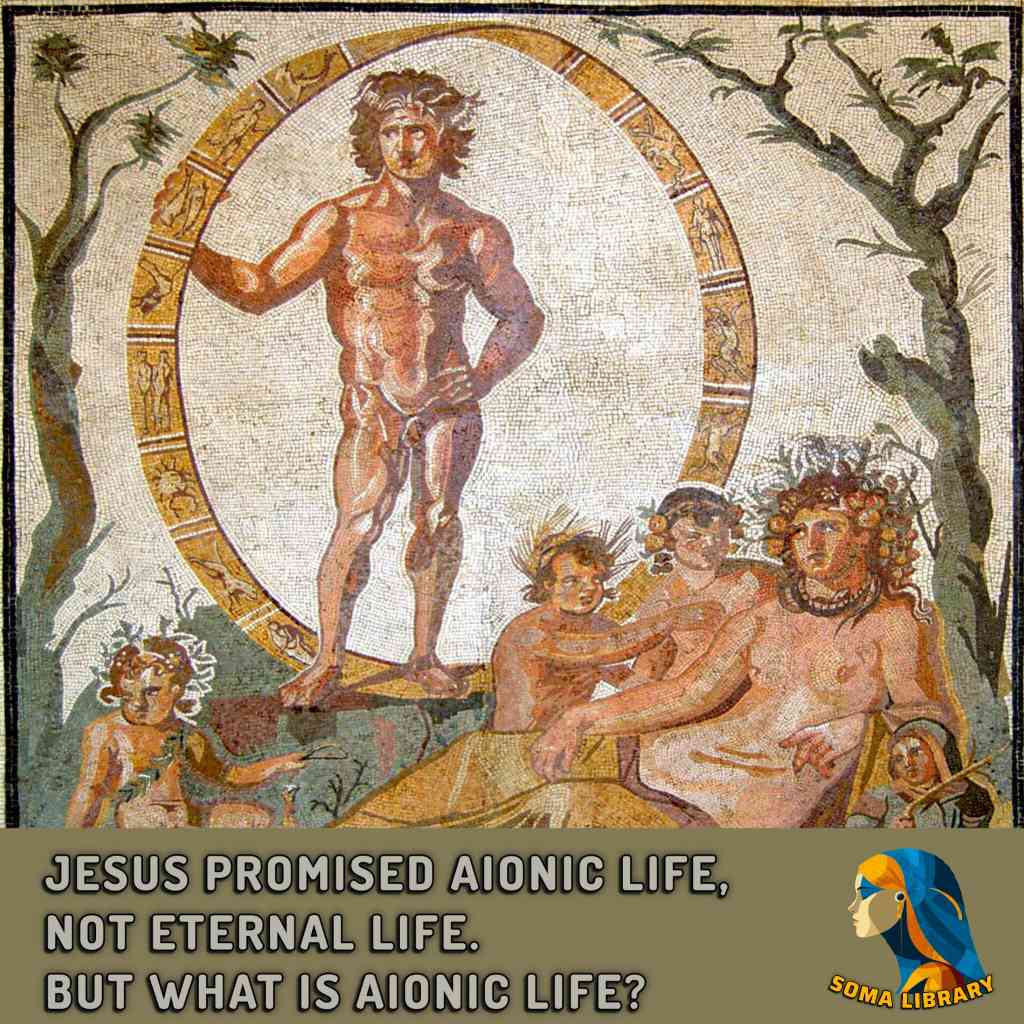
- Proof that Aionion (timeless perception) is not Adion (eternal time)
- Lexicon
- Some more context:
- See Also
John 3:16 - Nestle 1904
Breakdown
- Οὕτως — “thus, in this way”
- γὰρ — “for” (explanatory particle)
- ἠγάπησεν — “loved” (aorist of ἀγαπάω)
- ὁ Θεὸς — “the god” (nominative subject)
- τὸν κόσμον — “the structure / order of the mental realm” (accusative object)
- ὥστε — “so that”
- τὸν Υἱὸν — “the Son” (accusative, object of ἔδωκεν)
- τὸν μονογενῆ — “the only-begotten / unique-born” (accusative, in apposition to τὸν Υἱὸν)
- ἔδωκεν — “he gave” (aorist of δίδωμι)
- ἵνα — “in order that / so that”
- πᾶς — “every / all”
- ὁ πιστεύων — “the one trusting / believing” (present participle, nominative, functioning substantively)
- εἰς αὐτὸν — “into him” (εἰς = into, toward; accusative object αὐτόν)
- μὴ ἀπόληται — “may not perish / be destroyed” (aorist middle subjunctive of ἀπόλλυμι, negated with μή)
- ἀλλ’ — “but”
- ἔχῃ — “may have / hold” (present subjunctive of ἔχω)
- ζωὴν — “life"; psyche/soul as animated life force (accusative object of ἔχῃ)
- αἰώνιον — “of the timeless” (adjective modifying ζωήν).
Final Translation:
For in this way the god loved the kosmos (structure and order of everything and the inner mind): he gave the unique-born son, so that everyone who trusts him may not be destroyed (have a hellish experience), but may have aionic life (life/psyche/soul in the timeless mental state).
Key Term:
- αἰώνιον (aionic) - timeless; Note that eternal (ἀΐδιος / ἀΐδιον / adiodic) does not appear here
- ζωὴν (zoe) - animated life force, a word that refers to psuche (ψυχή), the psyche/soul (synonyms for what animates us)
- Aionic life. Is a mental state outside of time (Kronos).
Over time, in biblical writings and translations, the term aiounion (αἰώνιον - timeless) zoe (ζωὴν - animated life force, a word that refers to the psyche/soul) - timeless mental state - was reframed as eternal physical life. Why? Probably it was easy to confuse perception of time (what's in the mind) with real absolute time (similar yet different concepts), and an easy way for a priestly order to gain followers hoping for their life to continue forever. So we see those LSJ Victorians putting the word eternal into their lexicon. However historically, in the literature before the New and Old Testaments, in other Hellenic classical literature, aἰώνιον ζωὴν referred to a timeless state of mind, rather than something eternal.
Overall, it's a confusion about what exactly Jesus was offering to his followers. Mental states is harder to talk about, more ephemeral or ineffable to describe. The original Greek language bibles were the original (much evidence that the NT authors not only spoke and wrote Greek, but also relied on the Greek Old Testament).
Stabilized aionic life is non-reactive continuity and sustained mental presence. Especially useful when achieving higher mental states in self-work. Which we see in the ancient world all the time (Orphic Cosmology, Hermetic, Eleusis, Buddhist, Hindu, Genesis, Prayer, etc...).
Proof that Aionion (timeless perception) is not Adion (eternal time)
In Plotinus (Enneads III.7.3), aionios (αἰώνιος) and aidios (ἀΐδιος) must be distinct because Plotinus deliberately uses them side-by-side in the same sentence and then immediately asks whether they are identical or not. If αἰώνιος already meant ἀΐδιος, the question would be meaningless. Instead, Plotinus treats ἀϊδιότης as everlastingness—unbroken duration—while aion (αἰών) (and thus aionios αἰώνιος) names a mode of perception being outside duration altogether, the timeless perception from "presence" (which is a mentality), of the intelligible realm. The very grammar forces the distinction: aionios (αἰώνιος) describes how the intelligible world is present (perceived timelessly), while aidios (ἀΐδιος) describes that it does not cease (endlessly). Plotinus would not pose the problem unless the terms carried different ontological work, proving that αἰώνιος ≠ ἀΐδιος by usage, not assertion.
From His Treatise: “On Eternity and Time.”
(3) Τί ἂν οὖν εἴη τοῦτο, καθ' ὃ τὸν κόσμον πάντα τὸν ἐκεῖ αἰώνιον λέγομεν καὶ ἀίδιον εἶναι, καὶ τί ἡ ἀιδιότης, εἴτε ταὐτὸν καὶ ἡ αὐτὴ τῷ αἰῶνι, εἴτε κατ' αὐτὴν ὁ αἰών;
Lexicon
aion - timeless perception of time - from Heyschius Lexicon 400-500CE
ὁ βίος τῶν ἀνθρώπων, [ὁ τῆς ζωῆς χρόνος n ἆνερ, ἀπ' αἰῶνος νέος ὤλεο (Ω 725) Τινὲς δὲ τῶν νεωτέρων [τὸν νωτιαῖον <μυελὸν> ἀπέδωκαν, ὡς ἱπποκράτης· "<τὸν αἰῶνά τις νοσήσας ἑβδομαῖος ἀπέθανε>" d. ποτὲ δὲ καὶ ἐπὶ τοῦ μακροῦ χρόνου νοεῖται. καὶ ὁ ἐν παντὶ τῷ σώματι μυελός. Εὐριπίδης δὲ Φιλοκτήτῃ (fr. 801) <αἰῶνα> τὴν ψυχὴν λέγει· ἀπέπνευσεν αἰῶνα.
αἰών:
– The life of men; the span of life. (e.g. “Man, you perished young from your aion,” Iliad 24.725).
– Some later writers explained it as the spinal marrow, as in Hippocrates: “One who fell ill in the aion died on the seventh day.”
– Sometimes also it is understood in reference to long time in thought or perception (timeless mental state).
– Also, the marrow throughout the whole body.
– Euripides in Philoctetes (fr. 801) uses the word aion for the soul: “He breathed out his aion.”
Note Hippocrates refers to falling ill in the 7th day (that'd be our Sunday) as "dying" in the Aion (Sunday is a day to be Aionic). Which we see mirrored in the Septuagint Genesis narrative (on the 7th day... activity stops - after which time is irrelevant (not counted anymore) which marks a transition into timeless presence - that aion we're studying now; describes the entry into a condition where time no longer does anything).
aidios - eternal absolute time - from LSJ Perseus Tufts
NOTE: The LSJ (those 1800's victorians) have misinterpreted aion (αἰών). Here we gain insight from the earlier (contemporary) Heyschius Lexicon from 400-500CE, which tells us that Aion is the perception of time.
Perception of time is Relevant because it's a key point in common Orphic Cosmology, which influences hermeticism, Greek/Roman philosophers, as well as appearing in biblical sources like the Septuagint (see Genesis 1,2, Gaia and Ouranos, which mirrors that cosmology).
Some more context:
To make this all crystal clear.(paraphrased from Dr Hillman's Hamilton Morris Interview )
"In the Ancient Greek sources, the "Water of Life" comes from a bio-pharmacological substance (ejaculate from member of the priesthood who's subjected to venom pharmakon/drugs). We'd have to have a priestess, see that's the magic of the Mysteries. It is an Incarnation that Priestess is able to give “that which gives you Aionic life”, right? there is no such thing as “eternal life”, people have not read the Bible."
- Aionic Life (Ἀϊονικὴ ζωή) - Aion outside of time, timeless or divine dimension of consciousness. And life - Zoe denotes a more profound form of life.
- Aionic Life, in the context of pre-Christian mystery cults, can be understood as living life with conciousness in union with the divine, as promised to the initiates who underwent rites of initiation. These rites, often involving symbolic death and rebirth (as seen in the Eleusinian Mysteries), were designed to liberate the initiate's psyche from the confines of mortal existence (fear), offering the initiates an experience of life (without fear) that was beyond human time where times stands still (living in the present, constructive, creative, as a god would).
- experiences or rituals involving symbolic death (such as initiations where one "dies" and is reborn) creates a profound spiritual rebirth during the initiate’s lifetime, where the initiate gains access to a divine realm (level of consciousness) or cosmic order (structure of thinking) that transcends mortality and earthly suffering (fears). The initiate afterwards is now able to live without fear. This discovery of yourself is the cosmos. Learning to live in the present without anxiety of that future or depression of the past, without suffering.
- Aion (αἰών) - an experiential or transcendent state in which an individual steps outside the normal flow of time, often through altered states of consciousness (induced by pharmakon or other means). It is a timeless, mystical realm or condition where the individual gains access to knowledge or wisdom beyond the limitations of ordinary perception. Aion in this sense is not just a period of time (like an age or era) but a realm of existence that transcends chronological time. It represents a divine or otherworldly experience, where one can receive visions, insights, or revelations from outside the constraints of normal time. In the context of a pharmakomantis (drug seer), to be “in the Aion” is to enter a state of heightened perception or spiritual ecstasy, where one may perceive visions of the past, present, or future, often with the guidance or influence of substances that alter the mind. This state is seen as being outside of normal, linear time and offers a broader, cosmic perspective on existence. Aion is a key concept in mystical and prophetic traditions, where time becomes fluid, and the individual attains access to divine or cosmic wisdom, often experienced as a direct, non-linear insight into the nature of existence. See also Aion
- Zoe - (Ζωή) - pronounced like Zoë. Eve—life. Everything in the mystery revolves around dzoh-way. The Septuagint calls Eve life. Her name was a Bacchic shout—life! The devil gave her the fruit and said, "God’s a liar."
See Also
- see also Aion for more on the Aion
- see also Cosmic Egg - aion, gaia, ouranos are all parts of the egg, and initiation mental ordering.
- see also Mystery
- see also Genesis, which uses the Cosmic Egg (Gaia and Ouranos) mental ordering physics for initiation